


Introduction
India's eCommerce advertising landscape is changing rapidly.
For Amazon sellers, Flipkart sellers, D2C brands, manufacturers, and online retailers, the competition is no longer limited to who can spend the most on advertising.
Artificial intelligence is changing how products are discovered, how advertising campaigns are optimized, how customers are targeted, how product listings are created, and how marketplace businesses decide where to invest their budgets.
The change is already visible across major platforms.
Amazon India reported in 2026 that the share of Amazon advertisers in India using AI-powered tools had grown 77% year over year. Amazon also reported that Indian SMBs using these tools were producing significantly more advertising creatives and increasingly using AI for content generation, strategic planning, and competitor analysis.
Flipkart has also moved further into AI-powered seller advertising. In August 2026, Flipkart Ads launched Saarthi, combining an AI-powered campaign dashboard with expert advertising support. The platform provides campaign intelligence, product-level analysis, automated alerts, custom rules, and conversational recommendations for sellers.
Google is making a similar transition. In India, Google announced new AI-powered advertising and commerce capabilities in 2026, including AI Max for Shopping, AI Performance Insights, richer conversational product attributes, and tools designed around AI-driven discovery.
So what does all of this mean for Indian eCommerce businesses?
AI is moving from being a productivity tool to becoming part of the marketplace growth infrastructure.
For sellers, the opportunity is not simply to generate AI-written advertisements.
The bigger opportunity is to connect AI, marketplace SEO, advertising, product data, conversion optimization, and business strategy into one system.
What Is AI in eCommerce Advertising?
AI in eCommerce advertising means using artificial intelligence to analyze customer intent, advertising data, product information, campaign performance, creative assets, and shopping behavior to improve marketing decisions.
In a traditional advertising workflow, a seller may:
- Research keywords.
- Create campaigns.
- Select bids.
- Write ad copy.
- Monitor performance.
- Adjust budgets.
- Review search terms.
- Create new campaigns.
AI can assist with many of these tasks.
It can identify patterns in large datasets, suggest optimization opportunities, generate creative variations, categorize search intent, analyze product performance, and help marketers make decisions faster.
But AI does not eliminate the need for human strategy.
The most useful approach is:
AI analyzes and assists. Humans define goals, review recommendations, control budgets, and make strategic decisions.
Amazon's 2026 India SMB research supports this human-in-the-loop approach: only a small share of surveyed SMBs reported fully automated advertising decisions, while business owners and AI tools with human review remained important decision-making approaches.

Why AI Matters for Indian eCommerce Sellers in 2026
India has a highly competitive and diverse eCommerce environment.
A seller may be competing on:
- Amazon
- Flipkart
- Meesho
- Myntra
- Shopify
- Google Shopping
- Social commerce channels
- Regional marketplaces
Each platform has different customers, algorithms, advertising formats, pricing dynamics, and competition.
This creates a large amount of information to manage.
AI can help turn that information into actionable insights.
For example, an Indian apparel seller could use AI-assisted analysis to identify:
- Which products attract the most clicks
- Which search terms convert
- Which products have high advertising costs
- Which products have weak conversion
- Which campaigns waste budget
- Which categories are growing
- Which creatives need testing
- Which customer segments respond to particular messages
The result is not simply "more automation."
It is potentially faster decision-making across the entire eCommerce operation.
How AI Is Changing Amazon Advertising in India
Amazon remains one of the most important marketplaces for Indian online sellers.
The advertising environment on Amazon is also becoming more sophisticated.
1. AI Is Improving Amazon Campaign Optimization
Amazon advertising campaigns can contain hundreds or thousands of keywords, products, targets, bids, and placements.
Manually analyzing every variable can become difficult as a seller's catalog grows.
AI-powered systems can help identify patterns such as:
- High-performing search terms
- Low-converting targets
- Products consuming excessive budget
- Opportunities for bid adjustments
- Campaigns that need restructuring
- Products with strong conversion potential
- Search-term opportunities
This is particularly useful for sellers managing multiple SKUs.
GrainLeap's eCommerce PPC Management Services cover Amazon PPC, Flipkart campaigns, Google Shopping, keyword research, audience intent, campaign management, bid optimization, reporting, and performance analysis.
The objective should not be to automate every advertising decision.
The objective is to identify where human attention can create the greatest business impact.
2. AI Is Changing Amazon Advertising Creative
Creating advertising creative has traditionally required copywriters, designers, photographers, and video teams.
Generative AI is lowering some of those production barriers.
Amazon reported in 2026 that Indian SMBs are increasingly using AI-powered tools to create advertising assets, with many businesses using AI to experiment with formats and creative production.
For an Indian seller, this can make it easier to test:
- Different ad headlines
- Product benefits
- Promotional messages
- Lifestyle concepts
- Video advertisements
- Product-focused creative
- Audience-specific messaging
For example, a home décor seller might test separate creative themes around:
Affordable home styling
versus
versus
Easy-to-maintain décor for busy households
AI can help produce and iterate variations.
But the seller still needs to determine which positioning reflects the actual product.
3. AI Is Improving Amazon Product Discovery
The role of search is changing.
Customers increasingly use conversational language to describe what they want rather than entering short, exact keywords.
This means Amazon sellers need to think beyond individual keywords.
Consider:
Traditional keyword:
"cotton bedsheet"
Conversational intent:
"soft cotton bedsheet for summer that is easy to wash"
The second query communicates more information about the buyer's needs.
AI-powered search and shopping systems increasingly depend on contextual product information to understand these needs.
That makes product descriptions, attributes, specifications, images, and product benefits increasingly important.
A strong Amazon listing should help answer:
- What is this product?
- Who is it for?
- What problem does it solve?
- What makes it different?
- How is it used?
- What are its important specifications?
- What objections might a customer have?
How AI Is Changing Flipkart Advertising
Flipkart is particularly important for Indian sellers because of its strong domestic marketplace presence.
In August 2026, Flipkart introduced Saarthi, an AI-powered advertising initiative designed to provide sellers with campaign intelligence and expert support. According to Flipkart, the system includes product-level analysis, automated alerts, custom rules, day-parting capabilities, conversational AI, and actionable recommendations.
This development is significant because it illustrates a broader marketplace trend:
Advertising platforms themselves are increasingly embedding AI directly into seller tools.
What Does This Mean for Flipkart Sellers?
Instead of relying exclusively on manual reports, sellers can increasingly use intelligent systems to identify:
- Underperforming campaigns
- Product-level opportunities
- Budget optimization opportunities
- Advertising performance changes
- Campaign scheduling opportunities
- Areas requiring attention
For sellers, this means advertising management is becoming less about checking dashboards and more about interpreting recommendations and making business decisions.
AI-Powered Keyword Research for Amazon and Flipkart
Keyword research remains important in marketplace advertising.
But AI changes how keyword research can be performed.
Instead of creating a list of keywords based only on search volume, sellers can organize terms according to customer intent.
For example:
Informational Intent
"What is the best material for summer bedsheets?"
Commercial Intent
"best cotton bedsheet India"
Transactional Intent
"buy king size cotton bedsheet"
Product-Specific Intent
"6 piece king size cotton bedsheet set"
AI can help categorize large keyword datasets and identify patterns.
However, keyword volume should not be the only consideration.
A lower-volume keyword with strong buying intent can sometimes be more useful than a high-volume term that attracts shoppers who are unlikely to purchase.
This is why GrainLeap's approach to PPC includes buyer-intent mapping, long-tail keyword discovery, competitive intelligence, negative keyword filtering, and opportunity analysis.
AI and Marketplace SEO
Advertising is not the only area being transformed.
AI is also changing how sellers approach marketplace SEO.
Search engines and marketplace search systems need to understand products.
That requires good product data.
GrainLeap's eCommerce Marketing Services include marketplace search-intent keyword mapping, listing content optimization, technical SEO upgrades, CTR-focused titles and creative, backend keyword strategy, and conversion-focused optimization.
For Amazon and Flipkart sellers, an AI-ready listing should provide clear information about:
- Product category
- Brand
- Material
- Size
- Color
- Features
- Usage
- Compatibility
- Benefits
- Specifications
- Customer concerns
The objective is to make the product understandable to both people and search systems.
AI Is Making Product Data More Important
One of the biggest mistakes sellers can make is thinking AI means they can write less detailed product information.
The opposite can be true.
AI-powered discovery systems need useful product information to understand products.
Google's 2026 commerce announcements included "Global Conversational Attributes" intended to help merchants add richer conversational details to product listings. Google also announced AI Performance Insights for visibility across AI surfaces such as AI Overviews, AI Mode, and Gemini.
This indicates a broader shift toward richer product information.
For Indian marketplace sellers, product data should therefore be treated as a business asset.
AI and eCommerce Conversion Optimization
Getting an impression is not the same as generating a sale.
A customer may click an Amazon or Flipkart advertisement and still leave without purchasing.
Why?
Potential reasons include:
- Poor product images
- Weak product descriptions
- Unclear benefits
- Price concerns
- Lack of trust
- Weak reviews
- Confusing information
- Poor mobile experience
- Mismatch between ad and product page
This is where conversion optimization becomes important.
GrainLeap's Conversion Rate Optimization focuses on areas such as user behavior, A/B testing, conversion funnels, landing-page optimization, and customer experience.
AI can help identify patterns in customer behavior, but sellers still need to understand the commercial reason behind those patterns.
For example:
High clicks + low conversions
may indicate that the advertisement is effective at attracting attention but the product page is not successfully converting that interest.
Increasing advertising spend would not necessarily solve the underlying problem.
AI and Marketplace Advertising ROI
ROI is one of the most important considerations for marketplace sellers.
A campaign that generates sales is not automatically profitable.
Sellers should consider:
- Advertising cost
- Product margin
- Discounts
- Marketplace fees
- Shipping costs
- Returns
- Organic sales
- Customer lifetime value
- Inventory position
Metrics such as ROAS and ACOS can be useful, but they should be interpreted in the context of the entire business.
GrainLeap's How to Improve Marketplace Advertising ROI: 10 Common Issues & Solutions discusses issues including listing quality, search intent, bids, margins, campaign structure, and organic sales.
AI can make ROI analysis faster, but the business objective should remain clear:
Spend should support profitable and sustainable growth, not simply higher advertising activity.
AI and Multi-Marketplace Growth in India
A successful Indian eCommerce business may eventually want to sell across multiple marketplaces.
For example:
Amazon → Flipkart → Meesho → Shopify → International marketplaces
Managing this expansion creates operational complexity.
GrainLeap's Global Marketplace Management covers marketplace operations across platforms including Amazon, Walmart, Shopify, Etsy, and Flipkart, with attention to localization, pricing, compliance, content, and cross-border operations.
AI can support this multi-marketplace strategy by helping teams analyze:
- Product performance
- Marketplace-specific demand
- Search behavior
- Advertising performance
- Catalog information
- Customer questions
- Competitor positioning
The important point is that AI should not lead marketplace expansion without market research.
A product that performs well on Amazon may require different pricing, creative, positioning, or assortment on Flipkart.
AI Is Changing the Role of the eCommerce Manager
The traditional marketplace manager might spend significant time:
- Downloading reports
- Checking campaigns
- Updating spreadsheets
- Reviewing search terms
- Preparing listings
- Monitoring competitors
AI can reduce some of this manual workload.
The role can increasingly move toward:
- Strategy
- Analysis
- Testing
- Forecasting
- Product positioning
- Budget allocation
- Marketplace expansion
- Customer understanding
This is an important shift.
The value of an eCommerce professional increasingly comes from knowing what to do with information—not simply collecting information.
Common AI Mistakes Indian Marketplace Sellers Should Avoid
1. Publishing Unchecked AI Content
AI-generated product descriptions may contain incorrect claims.
Every product statement should be checked against the actual product.
2. Optimizing Only for Search Engines
A listing should not simply contain keywords.
It should help a real customer make a purchasing decision.
3. Automating Everything
AI recommendations should be reviewed.
Inventory constraints, margins, seasonal promotions, product launches, and business priorities require human judgment.
4. Ignoring Profitability
Higher ROAS does not automatically mean higher total profit.
5. Using the Same Strategy on Amazon and Flipkart
Each marketplace has different customers, competition, advertising environments, and merchandising dynamics.
6. Generating Too Many Creatives Without Testing
AI makes creative production easier.
That does not mean every creative deserves budget.
7. Ignoring Product Data
AI-powered shopping systems depend on accurate information.
Incomplete attributes can make product discovery more difficult.
A Practical AI Strategy for Amazon and Flipkart Sellers
Indian sellers can start with a simple five-stage framework.
Stage 1: Audit Your Product Data
Review:
- Titles
- Descriptions
- Images
- Attributes
- Specifications
- Categories
- Search terms
- Product benefits
Stage 2: Analyze Search Intent
Group search terms into:
- Discovery
- Research
- Commercial
- Transactional
- Brand
- Long-tail intent
Stage 3: Analyze Advertising
Identify:
- High-spend campaigns
- High-converting campaigns
- Low-conversion targets
- Wasted spend
- Product-level opportunities
- Budget gaps
Stage 4: Improve Conversion
Review:
- Product pages
- Images
- Reviews
- Pricing
- Offers
- Product information
- Customer objections
Stage 5: Scale Carefully
Once a product demonstrates healthy economics, consider increasing:
- Advertising budget
- Keyword coverage
- Marketplace presence
- Product assortment
- Geographic reach
This approach allows AI to support growth without allowing automation to become the strategy itself.
How GrainLeap Can Help Indian eCommerce Businesses
AI works best when it is connected to a broader eCommerce strategy.
GrainLeap provides services covering marketplace management, advertising, SEO, conversion optimization, product listings, and eCommerce marketing.
Its Amazon Marketing Optimization offering includes Amazon SEO and product listing optimization, sponsored advertising management, Brand Storefront and A+ Content support, competitor and keyword research, conversion optimization, and analytics.
For paid advertising, GrainLeap provides eCommerce PPC Management Services covering Amazon, Flipkart, Google Shopping, social advertising, campaign optimization, audience targeting, analytics, and reporting.
For businesses managing multiple channels, Global Marketplace Management supports marketplace operations, localized content, pricing, compliance, and expansion.
And for broader digital growth, GrainLeap's eCommerce Marketing Services combine marketplace SEO, Amazon and marketplace account management, PPC, content, and conversion-focused strategies.
The advantage of this connected approach is that advertising does not operate in isolation.
A campaign can be analyzed alongside:
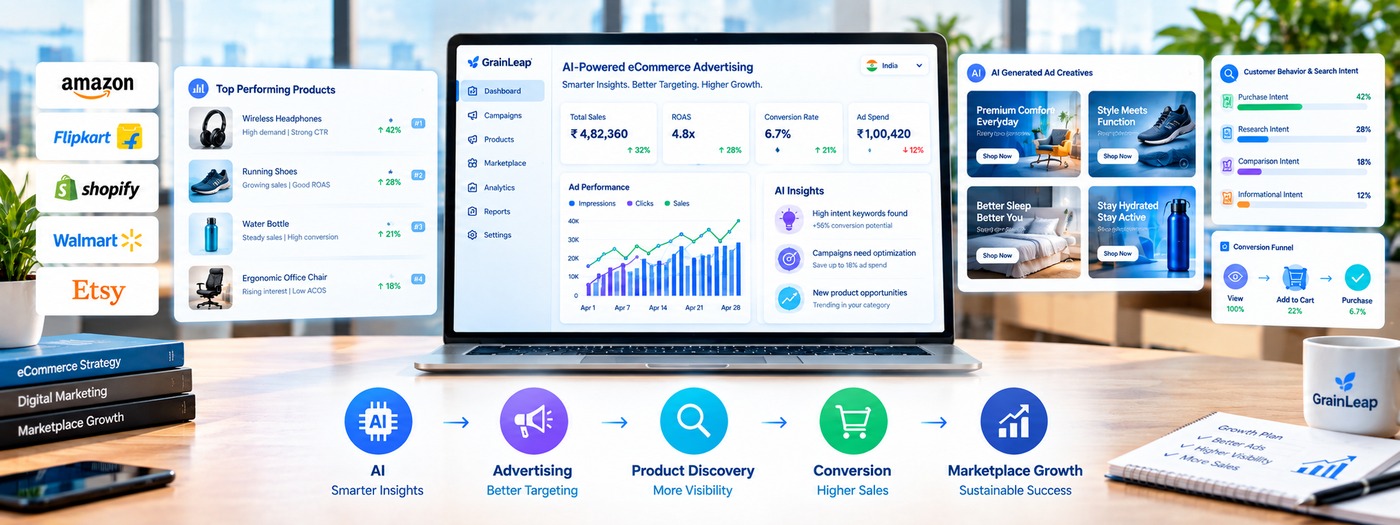
Product listing → Search visibility → Advertising → Conversion → Customer behavior → Marketplace growth
That is increasingly important in an AI-driven eCommerce environment.

12. FAQs
How is AI changing eCommerce advertising in India?
AI is changing eCommerce advertising through automated campaign analysis, smarter targeting, creative generation, search-intent interpretation, product discovery, and campaign optimization. Amazon and Flipkart are both expanding AI-powered advertising capabilities for sellers in India.
How can AI help Amazon sellers?
AI can help Amazon sellers analyze advertising performance, identify search-intent patterns, generate creative variations, optimize campaigns, improve product content, and identify potential growth opportunities.
How is AI changing Flipkart advertising?
Flipkart's 2026 Saarthi initiative introduced AI-powered campaign intelligence, automated alerts, product-level analysis, custom rules, day-parting, and conversational recommendations for sellers.
Is AI useful for Flipkart PPC?
Yes. AI can help analyze campaign performance, identify underperforming campaigns, find optimization opportunities, and support budget and bidding decisions. Human review remains important.
Will AI replace Amazon PPC managers?
AI can automate or assist with many repetitive tasks, but strategy, profitability analysis, product positioning, business objectives, and campaign governance still require human decision-making.
How does AI affect marketplace SEO?
AI is making detailed, structured product information increasingly important. Search and shopping systems need to understand product attributes, benefits, use cases, and customer intent.
Should Indian sellers use AI-generated product descriptions?
AI can be useful for creating drafts and variations, but product descriptions should always be reviewed for accuracy, marketplace policies, product claims, and brand consistency.
What is the biggest opportunity from AI for eCommerce sellers?
The biggest opportunity is not one particular AI tool. It is the ability to connect large amounts of marketplace, customer, product, and advertising data to faster and better business decisions.
13. GrainLeap CTA
Ready to Make Your Amazon or Flipkart Business AI-Ready?
AI is changing how Indian shoppers discover products and how marketplaces deliver advertising.
If your Amazon or Flipkart business still depends heavily on manual campaign management, disconnected reports, or outdated listing strategies, now is the time to rethink the system.
GrainLeap can help you combine marketplace management, PPC advertising, SEO, product listing optimization, conversion strategy, and data-driven growth into one eCommerce strategy.
Build a smarter marketplace growth strategy with GrainLeap.